
New to EVs? Start with How Does an Electric Vehicle Move? and come back. This guide assumes you know that an EV has a battery, an inverter and a motor.
What Fleming’s rules are, and are not
Fleming’s rules are hand mnemonics for finding the direction of one quantity when the other two are known. They are not independent laws of physics. The physics behind them is the Lorentz force on a moving charge and Faraday’s law of induction, covered in our physics laws guide (sections 2.3 and 2.5). The rules are a convenient way to apply that physics to a straight conductor in a magnetic field.
The Left-Hand Rule (motor action)
Hold the thumb, first finger and second finger of your left hand at right angles to each other. The first finger points along the magnetic field (north to south), the second finger along the conventional current (positive to negative), and the thumb then points in the direction of the force on the conductor.
F = B × I × L × sin θF is the force (newtons), B the magnetic flux density (tesla), I the current (amperes), L the length of conductor in the field (metres) and θ the angle between the conductor and the field. Force is greatest when the conductor is perpendicular to the field.
The Right-Hand Rule (generator action)
Use the right hand the same way, but now the thumb is the direction the conductor is moved, the first finger is the field, and the second finger shows the direction of the induced current.
E = B × L × v × sin θE is the induced EMF (volts) and v the speed of the conductor across the field (m/s).
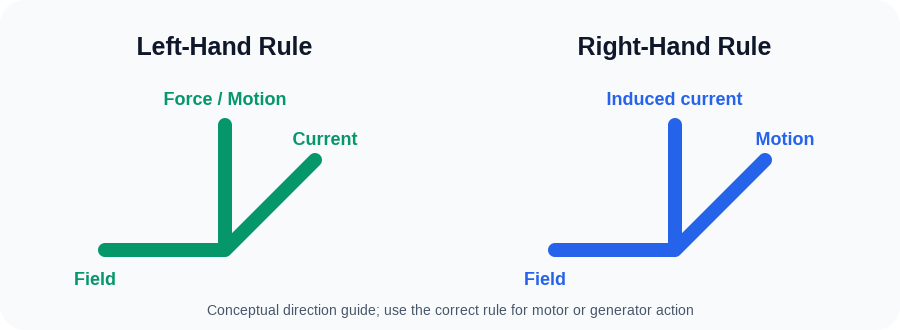
Worked examples
Motor: force on one conductor
A conductor 0.15 m long carries 100 A in a field of 0.8 T, perpendicular to it.
F = 0.8 × 100 × 0.15 = 12 N. A real motor has many conductors, and torque is the sum of their forces multiplied by their distance from the axis. For an illustration, 40 such conductors acting at a radius of 0.05 m would give 40 × 12 × 0.05 = 24 N·m. Real machines are lower because not every conductor is in the strongest part of the field at once.
Generator: voltage in one conductor
The same 0.15 m conductor moves at 10 m/s across the 0.8 T field.
E = 0.8 × 0.15 × 10 = 1.2 V. Double the speed and the voltage doubles, which is why a motor spinning faster generates a larger back-EMF.
Where this applies in an EV
Traction: the motor produces torque
The inverter feeds three-phase alternating current to the stator windings. That current creates a magnetic field that rotates around the stator, and the rotor follows it. The torque comes from the force on the current-carrying conductors in the magnetic field, which is the Left-Hand Rule applied to the whole machine. Our detailed working principle guide shows where this sits in the power flow.
Regeneration: the motor becomes a generator
When you lift off the accelerator the vehicle is still moving, so the rotor is still turning. The inverter controls the stator currents so that the torque on the rotor opposes the motion. The conductors are now being moved through a field, so the Right-Hand Rule applies, and the induced current is converted back to DC by the inverter and returned to the battery. Not all energy is recovered: conversion losses, battery limits and friction braking all take a share.
Back-EMF: both rules at once
Whenever a motor spins, generator action happens in it too, producing a voltage that opposes the supply (back-EMF). It rises with speed. This is part of why torque falls at high speed and why the controller uses techniques such as field weakening there. It is also why regeneration is limited when the battery is full or very cold: the system has nowhere to put the energy.
Common mistakes
- Using the wrong hand: left for motors (force), right for generators (induced current).
- Mixing up conventional current (positive to negative) with electron flow, which is the opposite.
- Treating the rules as laws, or applying them to a whole three-phase machine as if it were a single straight conductor. They give direction for one conductor; the machine adds geometry and rotating fields.
- Expecting regeneration to return all of the energy used to accelerate.
Explore interactively
The 3D animations show both rules on a motor model.
Left-Hand Rule 3D animationRight-Hand Rule 3D animation