
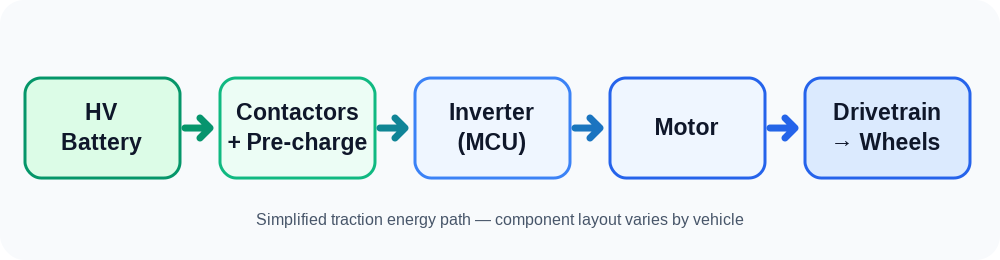
1. Energy is stored in the battery
An electric vehicle (EV) stores energy in a high-voltage (HV) battery. The battery supplies direct current (DC) electrical power to the vehicle's power-electronic system. A Battery Management System (BMS) monitors battery conditions such as voltage, current, temperature and state of charge.
2. The vehicle prepares to drive
When the driver switches the vehicle on, the low-voltage (LV) system powers the vehicle's control units. After safety checks, the high-voltage system is enabled. A pre-charge process is commonly used to charge the inverter's DC-link capacitors gradually before the main HV contactors close. This helps limit sudden inrush current.
3. The inverter supplies the motor
The battery stores and supplies DC power. A typical three-phase traction motor requires controlled alternating current (AC), so the traction inverter converts battery DC into controlled three-phase AC. The vehicle controller and motor control system regulate the electrical power according to driver demand.
HV Battery (DC) → Inverter (DC to AC) → Electric Motor
4. The electric motor produces rotation
Electric current flowing through the motor windings creates magnetic fields. Their interaction produces electromagnetic torque, which turns the motor rotor. In a permanent-magnet synchronous motor, the rotating magnetic field produced by the stator interacts with permanent magnets on the rotor. Other motor types work through different electromagnetic arrangements.
5. The drivetrain turns the wheels
The motor's rotation is transferred through the drivetrain. In many EVs, a reduction gearbox reduces motor speed and increases the torque available at the drive wheels. A differential distributes drive to the wheels and allows them to rotate at different speeds while cornering. The tyres push against the road, moving the vehicle forward.
Electric Motor → Reduction Gearbox → Differential → Drive Wheels
6. The vehicle can recover energy while slowing down
During regenerative braking, the moving vehicle drives the motor through the wheels and drivetrain. The motor operates as a generator and produces electrical energy. The inverter converts the generated electrical power into a form that can be returned to the HV battery, provided the battery and control system permit charging. Regenerative braking recovers only part of the vehicle's kinetic energy.
Wheels → Motor (Generator) → Inverter → HV Battery
Complete EV movement – at a glance
HV Battery → Power Distribution → Inverter → Electric Motor → Gearbox / Differential → Wheels
Related Physics Laws and Principles
The EV processes explained above are supported by several physics principles. Select a principle to read its explanation and EV application in our Physics Laws Used in EVs guide:
- Fleming's Left-Hand Rule – illustrates electromagnetic force direction in motor operation.
- Lorentz Force Law – describes the force on moving electric charges in electric and magnetic fields.
- Faraday's Law – explains induced voltage during generator operation.
- Fleming's Right-Hand Rule – helps determine induced-current direction.
- Lenz's Law – explains the opposing effect of induced current.
- Law of Conservation of Energy – explains energy conversion and partial recovery.
- Newton's Second Law – relates net force, vehicle mass and acceleration.