How to Calculate EV Range Using Battery SOC
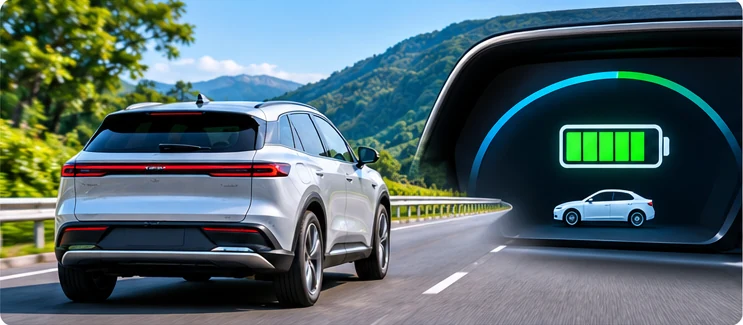
Technical terms at a glance
EV range is the distance a vehicle can travel using the energy available in its traction battery. A useful estimate combines the battery energy available over a selected state-of-charge (SOC) window with the vehicle's energy consumption. It is a planning estimate, not a guaranteed distance: speed, payload, gradients, weather, tyre pressure, traffic and cabin climate control all affect energy use.
1. Understand battery capacity and SOC
Battery capacity is commonly expressed in kilowatt-hours (kWh), a unit of energy. SOC is the estimated charge level shown by the vehicle, usually as a percentage. If a trip starts at 90% SOC and the planned arrival level is 20%, the planned SOC window is 70 percentage points.
Check whether the battery figure you use is the manufacturer's usable capacity or a nominal/gross figure. The battery management system may keep upper and lower buffers that are not available to the driver. For the most reliable estimate, use the capacity definition supplied for the vehicle.
2. Calculate the energy available in the SOC window
Worked example: Assume a vehicle has 40 kWh of usable battery capacity and the planned SOC window is 90% to 20%.
- SOC difference = 90 − 20 = 70 percentage points
- Energy available = 40 × 70 ÷ 100
- Estimated energy available = 28 kWh
This calculation assumes the displayed SOC is proportional to usable energy over that window. Actual BMS estimation and battery buffers can make the relationship less exact.
3. Convert available energy into estimated distance
If the example vehicle has 28 kWh available and its representative consumption is 16 kWh/100 km:
28 ÷ 16 × 100 = 175 km (estimated).
Use consumption measured on a route and in conditions similar to the planned journey. A city average may not represent sustained highway driving.
4. Understand Wh/km and kWh/100 km
| Display figure | Equivalent consumption |
|---|---|
| 120 Wh/km | 12 kWh/100 km |
| 160 Wh/km | 16 kWh/100 km |
| 180 Wh/km | 18 kWh/100 km |
| 200 Wh/km | 20 kWh/100 km |
Conversion: kWh/100 km = Wh/km ÷ 10. Conversely, Wh/km = kWh/100 km × 10. Keep units consistent before comparing two vehicles or trip records.
5. Estimate range from a real trip record
If you know the distance travelled and SOC consumed, you can estimate the vehicle's observed range over that operating window. For example, if a vehicle travels 100 km while SOC falls from 90% to 35%, it has used 55 percentage points. A simple linear estimate for a 90% to 20% window would be 100 × 70 ÷ 55 = about 127 km. Treat this as a route-specific estimate; consumption may change with speed, weather and terrain.
6. Why actual range changes
- Speed and aerodynamics: higher sustained speeds usually increase aerodynamic energy demand.
- Gradient: climbing consumes energy; regenerative braking can recover some energy on descents, but not all.
- Payload: passengers, luggage and roof loads can increase consumption.
- Climate control: heating and cooling draw energy, with impact varying by vehicle and conditions.
- Tyres and road: tyre pressure, tyre type, road surface, rain and wind influence rolling and aerodynamic resistance.
- Temperature: very hot or cold conditions can affect battery operation and cabin energy demand.
7. Practical trip-planning method
- Use the vehicle's usable battery capacity, where available.
- Choose a start SOC and a sensible arrival reserve rather than planning to reach 0%.
- Use recent consumption from a similar route, load and speed.
- Calculate energy for the planned SOC window and estimate distance.
- Check charger compatibility, operating status and a backup option before departure.
Frequently asked questions
Does 1% SOC always represent the same number of kilometres?
No. The distance represented by 1% depends on usable battery capacity and current energy consumption. Consumption changes with driving conditions.
Should I use gross or usable battery capacity?
Use the manufacturer's usable capacity when it is published. If only a gross/nominal figure is available, clearly treat the result as an approximation because protected battery buffers may not be accessible.
Why is highway range often lower than city range?
At sustained higher speeds, aerodynamic drag can increase energy use. Traffic patterns, temperature, elevation and regenerative braking also affect the comparison.
Is the dashboard range guaranteed?
No. It is an estimate based on vehicle data and assumptions about future use. Actual distance can differ when conditions change.
Use the EV Support Hub tools
Visit the EV calculators for a quick estimate and the charging station search to review charging options. Always verify live charger status and vehicle-specific limits before travel.