CCS2 DC vs Type 2 AC Charging: Key Differences
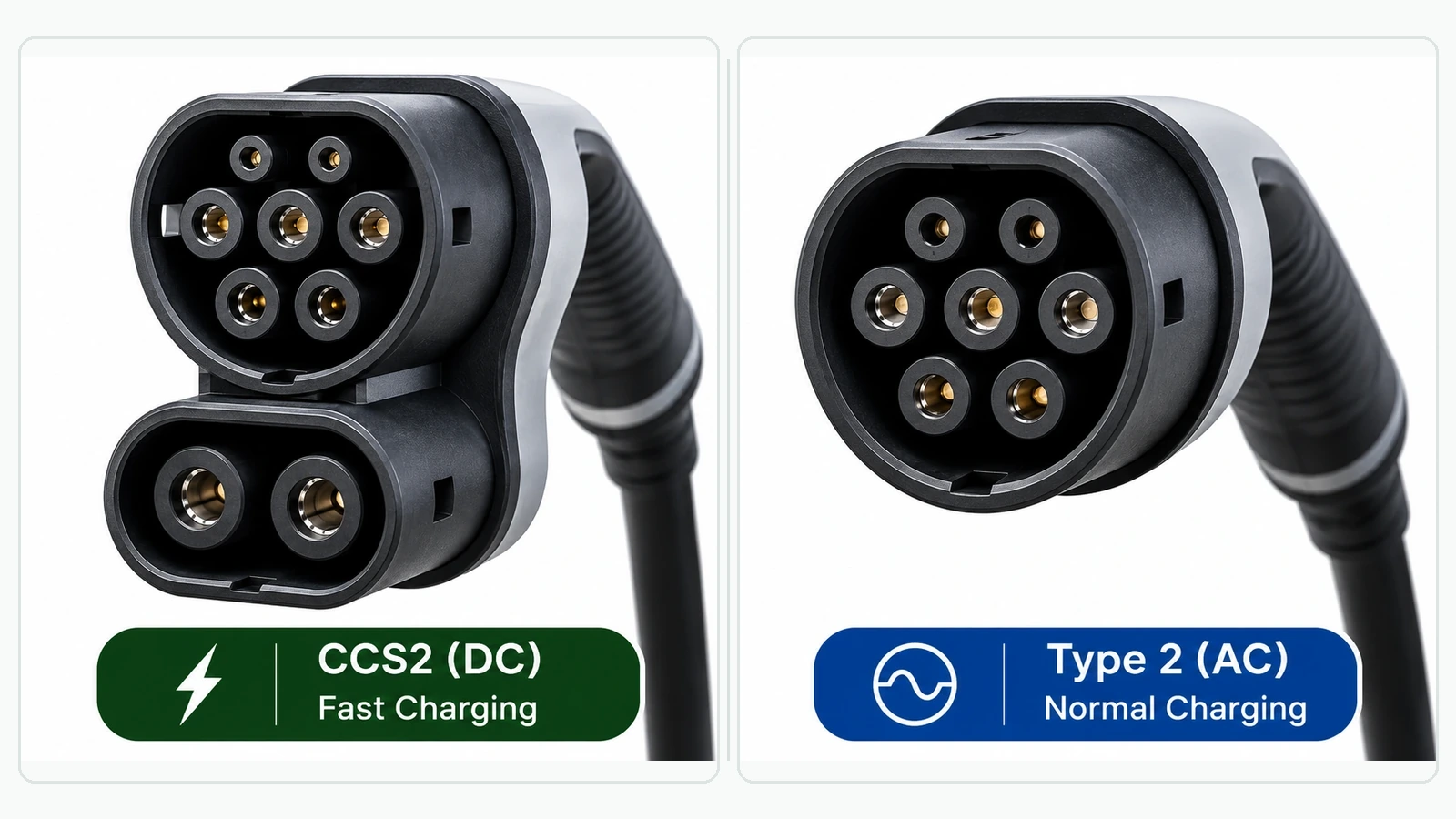
Technical terms at a glance
Type 2 AC and CCS2 DC are two common charging interfaces used by electric vehicles in India and other markets. They are related but serve different charging methods. Type 2 supplies alternating current (AC) to the vehicle, where the onboard charger converts it to DC for the battery. CCS2 supports DC fast charging, allowing the external charging equipment to supply controlled DC power to the vehicle's battery system.
1. Type 2 AC charging
With AC charging, the charging station supplies AC power and the vehicle's onboard charger (OBC) performs AC-to-DC conversion. The maximum AC charging rate is limited by the vehicle's OBC rating, the available supply and the charging equipment. A higher-rated AC station does not make a vehicle charge faster than its own OBC and electrical limits allow.
2. CCS2 DC fast charging
CCS2 combines the Type 2 AC interface with two additional large DC power contacts. During DC charging, conversion is performed by the off-board charger. The vehicle and charger communicate and manage the charging session within the limits of the battery, vehicle and charger.
3. Main differences
| Feature | Type 2 AC | CCS2 DC |
|---|---|---|
| Power supplied to vehicle | AC | DC |
| Where conversion happens | Inside vehicle OBC | Inside external DC charger |
| Typical use | Home, workplace and destination charging | Public rapid/fast charging |
| Vehicle limit | OBC rating and supply limits | Vehicle DC acceptance and battery limits |
| Charging time | Usually longer for the same energy amount | Can be faster when vehicle and charger support higher power |
4. Why an AC charger rating may not equal vehicle charging power
Consider a vehicle with a 6.6 kW onboard charger connected to a compatible 7.4 kW AC charging point. The vehicle is generally limited by its 6.6 kW OBC rating, and actual power may be lower due to supply voltage, current limits, temperature and conversion losses. A 3.3 kW OBC would not accept 7.4 kW simply because the station can provide it.
5. Estimate AC charging time
For example, adding 13.2 kWh at a steady 6.6 kW would take 13.2 ÷ 6.6 = 2 hours in an ideal calculation. Actual time can be longer because of conversion losses, power variation, battery temperature and charging limits.
6. Why DC charging power changes during a session
DC charging power is not necessarily constant from low SOC to high SOC. The vehicle's battery management system may request less power as SOC rises or when battery temperature is outside its preferred operating range. The charger also has its own voltage, current and power limits. This changing power profile is commonly called the charging curve or power taper.
Therefore, dividing the energy required by the charger's maximum advertised power can significantly understate the actual session time. Use vehicle-specific charging information when planning a trip.
7. Connector and compatibility checks
- Confirm the vehicle's inlet type and supported AC/DC charging methods.
- Check the station connector and whether the cable is tethered or requires a separate cable.
- Confirm the vehicle's maximum AC OBC rating and maximum DC acceptance power from reliable vehicle documentation.
- Check station operating status, access conditions, payment method and network instructions.
- Never force a connector or use damaged charging equipment.
8. Basic charging fault observations
If a session does not start, check the station display or app for an error, confirm the connector is fully inserted and locked, and follow the vehicle/network instructions. If the same issue occurs repeatedly, record the charger ID, time, vehicle warning and session details and contact the charging network or authorised vehicle support. Do not open the charger or attempt high-voltage repairs.
Frequently asked questions
Can a Type 2 AC vehicle use a CCS2 DC charger?
Only if the vehicle is equipped for the corresponding DC charging method and connector. A Type 2 AC inlet alone does not provide CCS2 DC capability.
Does a 60 kW DC charger always charge at 60 kW?
No. Actual power depends on the vehicle's DC acceptance limit, battery SOC and temperature, charger capability and site power conditions.
Is AC charging slower because of the onboard charger?
The onboard charger rating is one important limit. AC supply limits and conversion losses also affect the rate.
Can I use any CCS2 charger with any CCS2 vehicle?
Connector compatibility is necessary but not the only consideration. Check voltage/current compatibility, network access, charger status and the vehicle manufacturer's guidance.
Further reading and tools
Use EV Support Hub's charging station search and charging-time calculator. Confirm live availability and vehicle compatibility with the charging network before starting a journey.