
Key takeaways
- India-market e VITARA: LFP battery in 48.8 kWh and 61.1 kWh versions, 2WD, built on the HEARTECT-e platform.
- Claimed MIDC range is up to 440 km and 543 km; DC charging 10–80% is listed at about 45 minutes.
- Derived consumption is almost identical for both packs (about 111 and 113 Wh/km), so the larger pack buys range roughly in proportion.
- LFP trades some energy density for durability and tolerance of full charging, but is harder for the BMS to read accurately.
Battery and powertrain
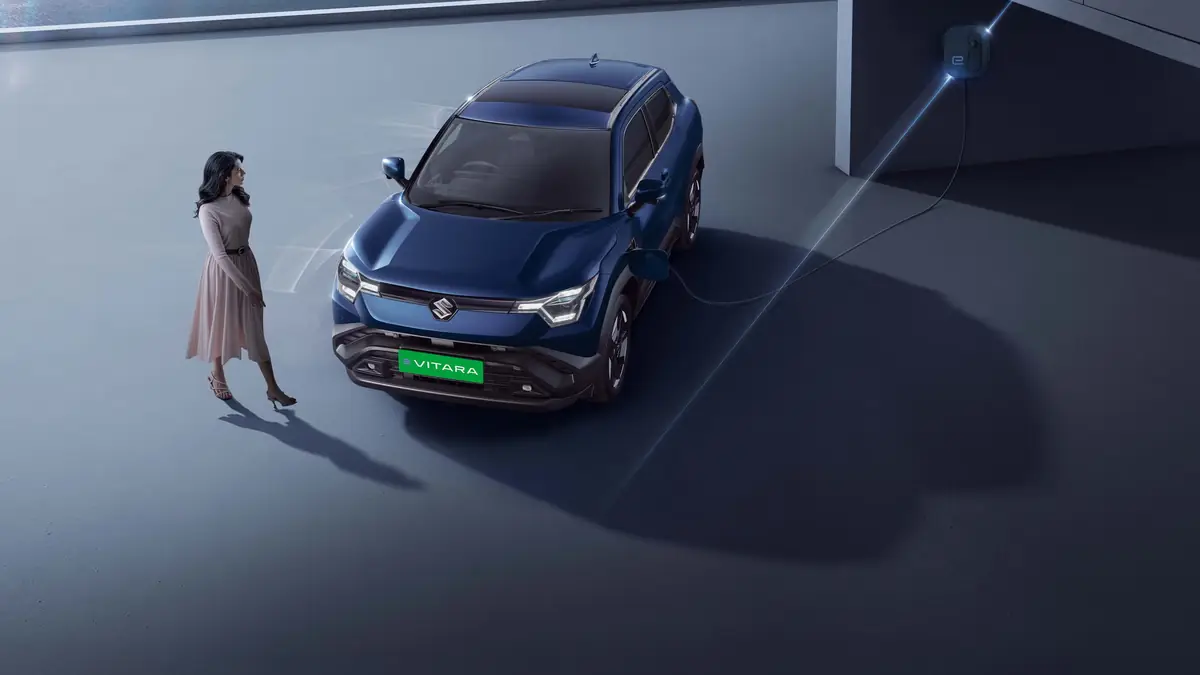
The Maruti Suzuki e VITARA is the company’s first battery-electric SUV for India. The Indian specification should be kept distinct from overseas versions and pre-launch descriptions.
| Specification | 49 kWh version | 61 kWh version |
|---|---|---|
| Battery chemistry | Lithium Iron Phosphate (LFP) | |
| Maximum motor power | 105.8 kW | 128 kW |
| Maximum torque | 193 Nm | |
| Drive (India specification) | 2WD | |
| Claimed MIDC range | Up to 440 km | Up to 543 km |
Maruti lists nominal capacities of approximately 48.8 kWh and 61.1 kWh; Maruti rounds them to 49 and 61 kWh in its headline figures. It also lists estimated DC rapid charging from 10% to 80% in about 45 minutes.
Technical interpretation
What LFP means in practice
LFP (lithium iron phosphate) cells store less energy per kilogram than nickel-based chemistries, which is why an LFP pack of a given range is heavier. In return they generally tolerate repeated charging to 100% better, offer long cycle life, and are less prone to thermal runaway. Their voltage curve is very flat across most of the state-of-charge range, so the BMS cannot read charge from voltage alone and relies more on current integration, with corrections at the ends. In practice, LFP owners are often advised to charge to 100% periodically so the displayed percentage stays accurate. Cold weather also reduces LFP charging speed more noticeably, which is one reason a battery thermal system matters. More background is in our BMS and thermal control guide.
Derived efficiency and what the bigger pack buys
| Version | Nominal capacity | Claimed range | Derived Wh/km |
|---|---|---|---|
| 49 kWh | 48.8 kWh | 440 km | ≈111 |
| 61 kWh | 61.1 kWh | 543 km | ≈113 |
The larger pack is about 25% bigger in capacity and delivers about 23% more claimed range. The shortfall is small and consistent with the extra mass of a bigger pack. (Derived = capacity × 1000 ÷ range, using nominal capacity.)
Same torque, different power
Both versions share 193 Nm of torque but differ in peak power (105.8 kW vs 128 kW). Using P = T × ω, that implies a base speed of roughly 5,250 rpm for the lower-power version and 6,350 rpm for the higher one (derived from Maruti’s rounded 193 Nm, assuming both peaks are available together). Take-off feel should therefore be similar, since torque governs it, while the 61 kWh version holds its pull to higher speeds. Neither figure is a measured performance claim.
What “10–80% in about 45 minutes” implies
That window is 70% of the pack, which is about 34 kWh on the 48.8 kWh pack and about 43 kWh on the 61.1 kWh pack. If the same 45-minute figure applied to both (the summary does not say which version it refers to), the implied average battery-side power would be roughly 46 kW and 57 kW respectively. These are modest averages, which is typical for a vehicle that should not be judged by a charger’s maximum rating. Autocar India’s specification page lists the 45-minute figure for the 61 kWh version against a 70 kW DC charger, which fits the higher of the two implied averages.
Worked example: a 61 kWh version on a 300 km trip
- Planning figure: use roughly 140 Wh/km for highway driving (an illustrative real-world assumption, higher than the derived 113 Wh/km).
- Energy for 300 km: 300 × 0.14 = 42 kWh, which is about 69% of 61.1 kWh.
- Starting from 90%, you would arrive at about 21%, leaving a reasonable reserve, so one short charge may be optional on a clear day and sensible in heat, hills or headwinds.
The highway trip planning guide explains how to choose that margin.
Specifications as per Maruti Suzuki
| Item | Delta (49 kWh) | Zeta (61 kWh) | Alpha (61 kWh) |
|---|---|---|---|
| AC charging 10–100% (7.4 kW, 1-phase) | ~6.5 h | ~9 h | ~9 h |
| DC rapid 10–80% | 45 min | ||
| Kerb weight | 1,730 kg | 1,790 kg | 1,820 kg |
| Gross vehicle weight | 2,180 kg | 2,250 kg | |
| Tyres | 225/55 R18 alloys with aero garnish | ||
- Dimensions: 4,275 × 1,800 × 1,640 mm, wheelbase 2,700 mm, minimum turning radius 5.2 m, five seats.
- Chassis: MacPherson strut front, multi-link rear, disc brakes all round with electronic parking brake.
- Battery warranty: 8 years or 1,60,000 km on the LFP battery.
- Motor: three-phase AC permanent-magnet synchronous, single-speed, 2WD.
- Colours: ten, including four dual-tone options with a bluish-black roof.
Battery as a Service (BaaS)
As per Maruti Suzuki, Battery as a Service (BaaS) works like this: you own the car and pay a fixed monthly fee for the battery instead of buying it upfront, which lowers the upfront cost. Maruti notes that the vehicle stays hypothecated to the financier, that taxes, registration and charging costs are extra, that it is available with select financiers for private registrations, and that terms can change. Compare the total over your expected ownership period with buying the battery outright; our long-term cost calculator method shows how to do that kind of comparison.
What the charging numbers imply
A 10–80% charge on the 61 kWh pack adds about 42.7 kWh. In 45 minutes that is an average of roughly 57 kW into the battery (derived), well below the peak rate of fast chargers, which fits an LFP pack that is conservative in cold or very high states of charge. On AC, 61.1 kWh over about 9 hours at 7.4 kW implies roughly 6.8 kW average into the pack for a full 10–100% charge (derived), so an overnight plug-in is the normal pattern.
Official sources
- Maruti Suzuki – e VITARA launch and technical specifications
- Maruti Suzuki – official e VITARA specifications