
Key takeaways
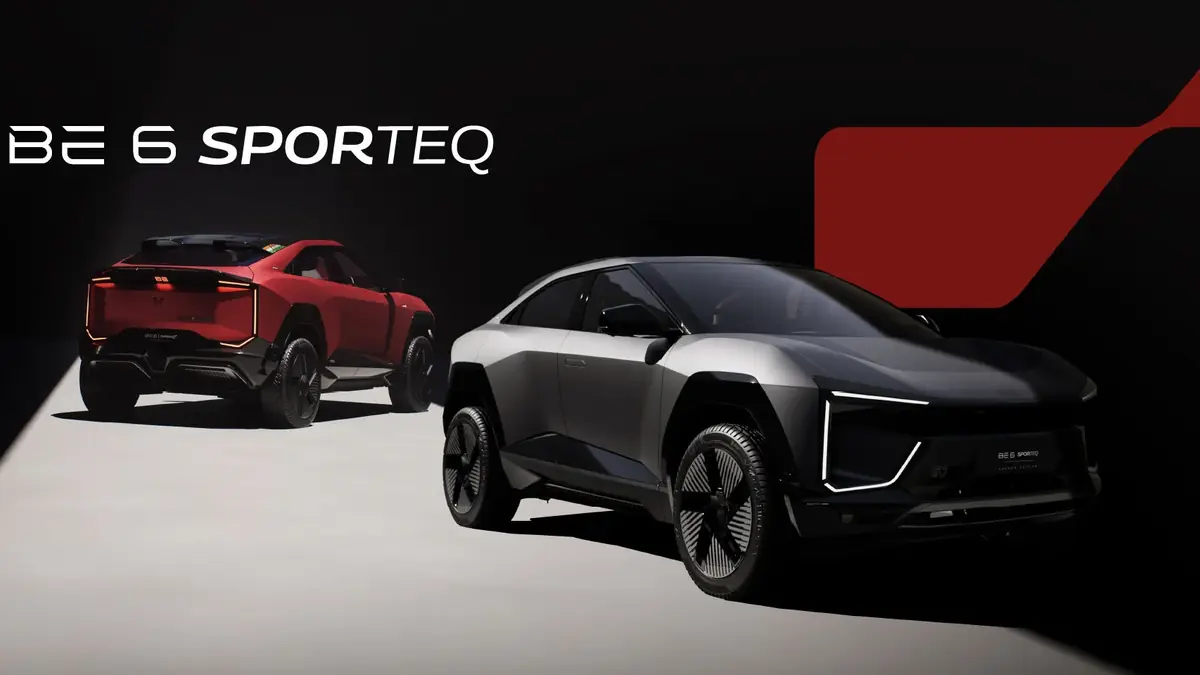
- The BE 6 and XEV 9e share the INGLO platform. As per Mahindra, the BE 6 SPORTEQ has 360 Nm of torque and the XEV 9e 380 Nm. The BE 6 also offers a 70 kWh pack, and its headline range is higher (up to 708 vs up to 656 km MIDC, both on the 79 kWh pack).
- Using P = T × ω, the published power and 380 Nm of torque imply a motor base speed of roughly 4,300–5,600 rpm, meaning full torque is available up to there and power plateaus beyond it.
- Peak motor power works out to about 2.6–2.9 kW per kWh of pack capacity across the packs: bursts, not sustained load.
- Certified range is a test-cycle figure. Plan real trips more conservatively.
Published specifications
Mahindra’s electric-origin SUVs use the INGLO platform. Battery capacity, motor output and range depend on model, variant and model year, so the BE 6 and XEV 9e should not be treated as having identical specifications.
| Specification | Mahindra BE 6 | Mahindra XEV 9e |
|---|---|---|
| Battery options | 59, 70 and 79 kWh (variant dependent) | 59 and 79 kWh (variant dependent) |
| Motor power | 170, 180 or 210 kW | 170 or 210 kW |
| Maximum torque | 360 Nm | 380 Nm |
| Drive type | Rear-wheel drive | Rear-wheel drive |
| MIDC P1+P2 range | 573 / 652 / 708 km (59 / 70 / 79 kWh) | 522 / 656 km (59 / 79 kWh) |
| DC charging 20–80% | 20 min (140 / 160 / 180 kW, 400 A charger input) | 20 min (140 kW input for 59 kWh; 180 kW for 79 kWh) |
| AC wall charger, 0–100% (11.2 kW) | 6 / 7 / 8 h | 6 / 8 / 11.7 h (charger options vary by variant) |
| Length × width × height | 4,371 × 1,907 × 1,627 mm | 4,789 × 1,907 × 1,694 mm |
| Wheelbase | 2,775 mm | 2,775 mm |
| Boot / frunk | 455 L / 45 L | 663 L / 150 L |
Technical interpretation
Power, torque and base speed
Mechanical power is torque multiplied by angular speed (P = T × ω). A traction motor holds roughly constant torque from standstill up to its base speed, then power stays roughly constant while torque falls as speed rises. If the published peak torque and peak power are both available in a variant, base speed is approximately P ÷ T, converted to rpm.
rpm ≈ (P in watts ÷ T in Nm) × 60 ÷ 2π| Model | Power / torque pairing | Derived base speed |
|---|---|---|
| XEV 9e (59 kWh) | 170 kW / 380 Nm | ≈4,270 rpm |
| BE 6 SPORTEQ (59 kWh) | 170 kW / 360 Nm | ≈4,510 rpm |
| BE 6 SPORTEQ (70 kWh) | 180 kW / 360 Nm | ≈4,770 rpm |
| XEV 9e (79 kWh) | 210 kW / 380 Nm | ≈5,280 rpm |
| BE 6 SPORTEQ (79 kWh) | 210 kW / 360 Nm | ≈5,570 rpm |
These are derived and assume the full rated torque is available up to that speed; the real torque-speed curve is not published. The useful insight is practical: within each model every variant shares the same torque rating (360 Nm for the BE 6 SPORTEQ, 380 Nm for the XEV 9e), so the variants should feel similar from a standstill, and the 210 kW version separates itself at higher road speeds, for example when overtaking on a highway.
Peak power versus battery size
Dividing peak motor power by pack capacity (kW per kWh, the same idea as a C-rate) gives about 2.9 for the 59 kWh pack (170 kW), 2.6 for the 70 kWh pack (180 kW) and 2.7 for the 79 kWh pack (210 kW). Drawing that rate continuously would empty a pack in well under half an hour, which is exactly why peak power is only used in short bursts. The ratio is similar across the range, so no pack is being asked to work much harder than another, and the BMS and thermal system exist to manage the bursts. See our BMS and thermal control guide.
Why the BE 6 shows a longer headline range
The BE 6’s “up to 708 km” belongs to the 79 kWh pack as per Mahindra’s BE 6 SPORTEQ specifications. The XEV 9e’s “up to 656 km” is also the 79 kWh figure. On the same 79 kWh capacity that is about 112 Wh/km for the BE 6 and 120 Wh/km for the XEV 9e, a gap of roughly 7%. A larger, heavier vehicle with a bigger frontal area generally consumes more, so a gap in that direction is plausible. That reading is our inference, not something Mahindra states.
Worked example: charging time on the 79 kWh pack
Take a 79 kWh pack charged from 20% to 80% on a DC charger that delivers an average 100 kW to the battery (illustrative; real power tapers and depends on temperature and the vehicle’s limits).
- Energy added: 79 × (0.80 − 0.20) = 47.4 kWh.
- Time at 100 kW average: 47.4 ÷ 100 = 0.474 h ≈ 28 minutes.
The same arithmetic at a more typical 60 kW average gives about 47 minutes. This is why average power over the session, not a charger’s headline rating, decides your stop length. The charging-time method page shows how our estimator treats this.
Charging and real-world use
Charging time depends on charger input, state of charge, temperature and the vehicle’s charge-acceptance limits. Do not assume a station’s maximum power is delivered continuously. Certified range figures are test-cycle results, not guaranteed everyday range; speed, HVAC use, terrain, payload, temperature and tyre condition all matter. As per Mahindra, 20–80% DC charging takes 20 minutes when the charger can supply 140–180 kW at 400 A, and the times vary with ambient and battery temperature, air-conditioning use and charger output. As per Mahindra, both models carry a lifetime HV battery warranty for the first registered private owner (10 years or 2,00,000 km after a change of ownership). For a closer look at the newer model, read our BE 6 SPORTEQ analysis.
Official sources
- Mahindra – official BE 6 SPORTEQ and XEV 9e specifications, checked 27 November 2026
- Mahindra Electric SUVs – official website
- Mahindra Electric SUVs – official FAQs